

Somewhere between science and spirituality sits a system that Indian sages have trusted for thousands of years — Vedic astrology. If you’ve ever wondered what is Vedic astrology and why so many people, from farmers planning their harvest to CEOs planning their next move, still consult it before making big decisions, you’re in the right place. I’ve spent years studying and practicing Jyotish, and I can tell you this: most people who ask about Vedic astrology have already heard something about “sun signs” from a Western horoscope app. That’s not wrong, exactly, but it’s only a small slice of a much bigger, older, and more precise tradition. This guide will walk you through what Vedic astrology actually is, where it came from, how it’s structured, and how it’s genuinely different from the astrology you read in your daily newspaper.
By the end, you’ll understand enough to have an intelligent first conversation with any astrologer — including me.
Table of Contents
- What Is Vedic Astrology?
- History and Origin of Jyotish
- What Does “Jyotish” Actually Mean?
- Core Principles of Vedic Astrology
- The Nine Planets (Navagraha)
- The Twelve Houses (Bhavas)
- The Twelve Zodiac Signs (Rashis)
- Nakshatras: The 27 Lunar Mansions
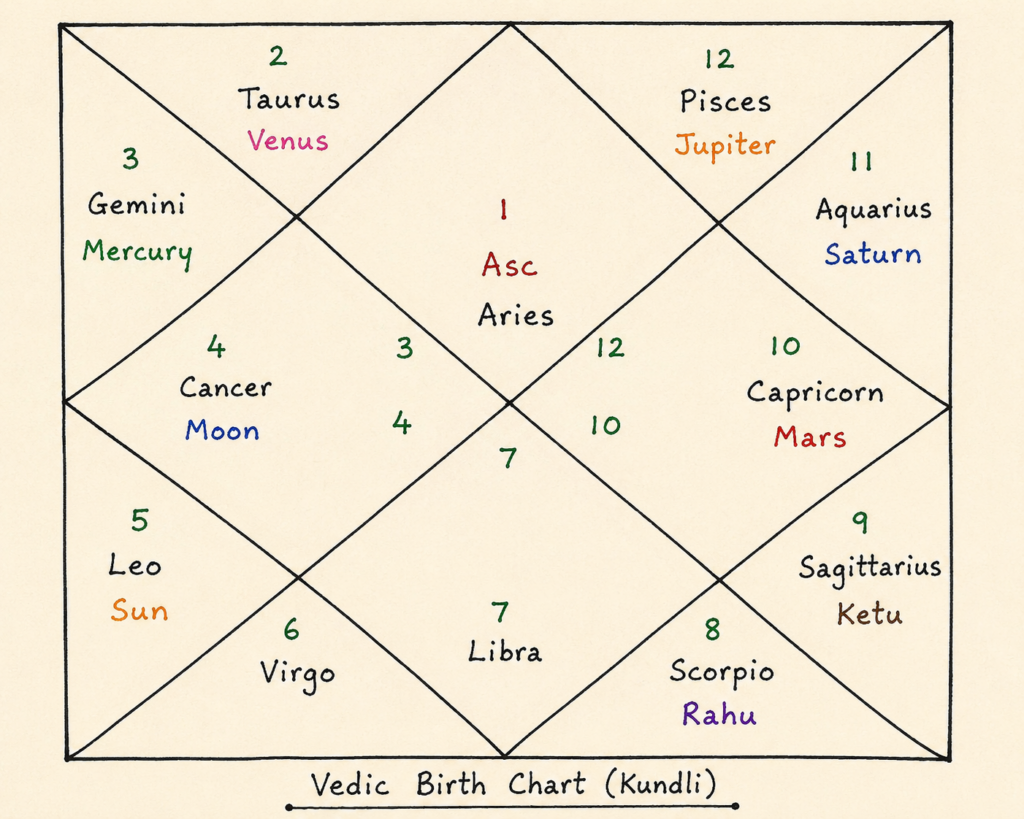
- What Is a Birth Chart (Kundli)?
- The Dasha System
- Planetary Transits (Gochar)
- The Role of Karma in Vedic Astrology
- How Predictions Are Actually Made
- Vedic Astrology vs Western Astrology
- Benefits of Vedic Astrology
- Common Misconceptions
- Who Should Learn Vedic Astrology?
- When Should You Consult an Astrologer?
- Final Takeaways
- FAQs
What Is Vedic Astrology?
Vedic astrology, also called Jyotish Shastra, is an ancient Indian system that studies the positions of planets, the moon, and stars at the exact moment of a person’s birth to understand their personality, life patterns, and potential future events. The word “Vedic” comes from the Vedas, the oldest sacred texts of India, where the earliest seeds of this science were first recorded.
Unlike a quick horoscope you skim in the morning, Vedic astrology is built entirely around your Janam Kundli — a detailed birth chart calculated using your exact date, time, and place of birth. It maps where every planet sat in the sky the moment you took your first breath, and astrologers use that map to read patterns in your life: career, relationships, health, wealth, and timing of major events.
What sets it apart is precision. Vedic astrology uses the sidereal zodiac, which is aligned with the actual, observable position of the stars, rather than the Western tropical zodiac, which follows the seasons. This one difference changes almost everything about how a chart is read, and we’ll get into that shortly.
At its heart, Vedic astrology isn’t about predicting doom or guaranteeing fortune. It’s a guidance system — a way of understanding the karmic patterns already woven into your life, so you can make more conscious choices going forward.
History and Origin of Jyotish
Jyotish is one of the six Vedangas, or auxiliary disciplines, that ancient scholars studied to properly understand the Vedas. Its roots trace back over 5,000 years, with early astronomical observations recorded in texts like the Rigveda. Later, classical scholars such as Parashara, Varahamihira, and Jaimini systematized the practice into the structured discipline we recognize today.
Sage Parashara’s work, the Brihat Parashara Hora Shastra, is still considered the foundational text of modern Vedic astrology. Most of the principles taught by practicing astrologers, including the house system, planetary relationships, and dasha calculations, trace directly back to this text.
What’s remarkable is how little the core framework has changed. While tools have evolved from hand-drawn charts and astronomical tables to software calculations, the underlying logic Parashara laid out remains the backbone of the practice.
What Does “Jyotish” Actually Mean?
The word Jyotish comes from the Sanskrit word “Jyoti,” meaning light. Loosely translated, Jyotish means “the science of light” — a fitting name for a system built around observing celestial bodies. Ancient astrologers saw the planets and stars as sources of light that carried information about time, fate, and cosmic order.
You’ll often see Vedic astrology referred to interchangeably as Jyotish Shastra, Hindu astrology, or Indian astrology. They all point to the same tradition, just with slightly different regional or academic phrasing.
Core Principles of Vedic Astrology
A few ideas form the backbone of every Vedic astrology reading:
- The sidereal zodiac. Positions are calculated based on the fixed stars, not the shifting seasons.
- Karma and dharma. Your chart is thought to reflect karmic patterns carried forward, along with your dharma, or life purpose.
- The birth chart as a blueprint. Your Kundli isn’t a prediction machine — it’s a map of tendencies and probable timing.
- Planetary strength and placement. A planet’s effect depends heavily on which sign, house, and nakshatra it occupies, plus its relationship with other planets.
- Time as a living force. Through the dasha system, Vedic astrology treats time itself as something that activates different planetary energies at different life stages.
Understanding these five ideas will make everything else in this guide click into place much faster.
The Nine Planets (Navagraha)
Vedic astrology works with nine celestial bodies, known as the Navagraha:
| Planet | Sanskrit Name | Represents |
|---|---|---|
| Sun | Surya | Soul, authority, father |
| Moon | Chandra | Mind, emotions, mother |
| Mars | Mangal | Energy, courage, conflict |
| Mercury | Budh | Intellect, communication |
| Jupiter | Guru | Wisdom, growth, fortune |
| Venus | Shukra | Love, beauty, relationships |
| Saturn | Shani | Discipline, delay, karma |
| Rahu | North Node | Ambition, obsession, illusion |
| Ketu | South Node | Detachment, spirituality, past life |
Notice that Rahu and Ketu aren’t physical planets at all — they’re the lunar nodes, the points where the moon’s orbit crosses the sun’s path. Vedic astrology treats them as shadow planets, and honestly, some of the most interesting chart readings I’ve done center entirely on how a person’s Rahu and Ketu play out over their lifetime.
The Twelve Houses (Bhavas)
Each birth chart is divided into twelve houses, and each one governs a different area of life:
- Self, personality, physical body
- Wealth, family, speech
- Courage, siblings, communication
- Home, mother, emotional foundation
- Creativity, children, intelligence
- Health, enemies, daily work
- Marriage, partnerships
- Transformation, longevity, hidden matters
- Luck, higher learning, dharma
- Career, public status
- Gains, income, aspirations
- Losses, spirituality, foreign connections
When an astrologer looks at your chart, they’re essentially asking: which planets sit in which houses, and what does that combination mean for that particular life area? A strong Jupiter in the tenth house, for instance, often points toward a respected, growth-oriented career.
The Twelve Zodiac Signs (Rashis)
You’ve likely heard of the twelve zodiac signs, or Rashis, before: Aries (Mesh), Taurus (Vrishabh), Gemini (Mithun), Cancer (Kark), Leo (Simha), Virgo (Kanya), Libra (Tula), Scorpio (Vrishchik), Sagittarius (Dhanu), Capricorn (Makar), Aquarius (Kumbh), and Pisces (Meen).
Here’s the catch: because Vedic astrology uses the sidereal zodiac, your Vedic moon sign or rising sign will often differ from your Western sun sign by roughly 23 to 24 degrees. Someone who identifies as a Western Leo might actually be a Vedic Cancer. This surprises almost every beginner I talk to, and it’s usually the first “aha” moment people have when they start learning Jyotish seriously.
Nakshatras: The 27 Lunar Mansions
Beyond the twelve zodiac signs, Vedic astrology divides the sky into 27 nakshatras, or lunar mansions, each spanning 13 degrees and 20 minutes. Nakshatras add remarkable precision to a reading. Two people born under the same moon sign can have very different personalities and life timing depending on which nakshatra their moon falls in.
Each nakshatra has its own ruling planet, symbol, mythology, and personality traits. Ashwini, the first nakshatra, is associated with speed and healing. Rohini is tied to beauty and material comfort. Learning the nakshatras is often what separates a casual astrology hobbyist from someone who can offer genuinely nuanced readings.
What Is a Birth Chart (Kundli)?
Your birth chart, or Janam Kundli, is a snapshot of the sky at the exact moment and location of your birth. It plots where each of the nine planets sat within the twelve houses and twelve signs at that instant.
To generate an accurate Kundli, an astrologer needs three things: your date of birth, your precise time of birth, and your place of birth. Even a difference of a few minutes can shift your ascendant, or Lagna, which changes the entire house structure of your chart. This is why I always ask clients to double-check their birth certificate or hospital records before we begin a serious reading. If you’d like to see this in action, you can generate your free Kundli online in just a few minutes.
Your Kundli becomes the single reference document for everything else — dasha timing, compatibility matching, career guidance, and remedial suggestions all flow from this one chart.
The Dasha System
One of the most distinctive features of Vedic astrology, and something Western astrology doesn’t really have an equivalent for, is the dasha system. Dashas are planetary periods that unfold across your lifetime in a fixed sequence, each ruled by a different planet.
The most widely used framework is the Vimshottari Dasha, a 120-year cycle divided among the nine planets. During your Jupiter dasha, for example, themes of growth, wisdom, and opportunity tend to take center stage. During a Saturn dasha, life often asks you to slow down, work harder, and build discipline.
This is the tool astrologers use to answer the question clients ask most often: not just “what will happen,” but “when will it happen.” It’s genuinely one of the most practical parts of a Vedic astrology consultation.
Planetary Transits (Gochar)
While your birth chart is fixed, the planets themselves keep moving. Gochar, or transit astrology, tracks how current planetary positions interact with your natal chart. A Saturn transit over your moon sign, for example, is often felt as a period of pressure and restructuring — commonly known as Sade Sati.
Transits work alongside your dasha period, not instead of it. Think of your dasha as the general chapter of your life story, and transits as the specific events happening within that chapter.
The Role of Karma in Vedic Astrology
Karma is central to how Vedic astrology interprets a chart. The tradition holds that your birth chart reflects the karmic residue you’re carrying into this lifetime — not as punishment, but as unfinished lessons and patterns still working themselves out.
This is an important distinction from fatalism. Vedic astrology doesn’t say your life is locked in stone. It says certain tendencies and timings are more likely based on karmic patterns, and understanding them gives you the awareness to respond wisely rather than react blindly.
How Predictions Are Actually Made
A genuine Vedic astrology reading isn’t a single glance at your sun sign. It’s a layered process:
- Calculating your accurate birth chart and ascendant
- Identifying planetary strength, placement, and relationships
- Reviewing relevant house significations for your question
- Cross-checking the current and upcoming dasha periods
- Factoring in ongoing transits
- Synthesizing all of this into a coherent, grounded interpretation
Skilled astrologers rarely rely on just one factor. A planet that looks “bad” in one house might behave quite differently once you account for its dasha timing or its relationship with the chart’s ruling planet. This is exactly why generic, one-size-fits-all astrology predictions found online should be taken with a grain of salt.
Vedic Astrology vs Western Astrology
These two systems are often confused, but they diverge in some fundamental ways.
| Aspect | Vedic Astrology | Western Astrology |
|---|---|---|
| Zodiac used | Sidereal (star-based) | Tropical (season-based) |
| Primary focus | Moon sign and ascendant | Sun sign |
| Time-based predictions | Yes, via dasha system | Less structured |
| Origin | Ancient India, Vedic texts | Ancient Greece, adapted through Europe |
| Chart emphasis | Karma, dharma, life timing | Psychology, personality traits |
If you’re weighing the two systems for your own reading, a Vedic astrologer in India can walk you through exactly how your Vedic and Western placements compare.
Benefits of Vedic Astrology
People turn to Jyotish for genuinely practical reasons, not just curiosity. It can help you:
- Understand your natural strengths and recurring challenges
- Get a sense of favorable timing for major life decisions
- Approach relationships with more self-awareness
- Find clarity during uncertain or transitional periods
- Reconnect with a spiritual framework that’s stood the test of thousands of years
Many clients also pair their reading with complementary practices such as gemstone remedies, numerology, or Vastu Shastra for their home or workplace, since all three draw on the same underlying Vedic principles. None of this replaces your own judgment or effort, though. Think of it as a second, well-informed opinion — not a replacement for common sense.
Common Misconceptions
Let’s clear up a few things I hear constantly:
“Vedic astrology can predict the exact date I’ll get married.” It can point to favorable periods based on dasha and transit patterns, but it can’t hand you a calendar date with certainty. Even placements like Manglik Dosha, which people worry about most, are far more nuanced than a simple yes-or-no verdict.
“If my chart looks bad, my life is ruined.” No chart is entirely “bad.” Every chart has strengths and challenges, and remedial measures exist precisely to help you work with difficult placements.
“Vedic and Western astrology are basically the same thing with different names.” As we covered above, the zodiac systems, calculation methods, and philosophical foundations are genuinely different.
“You need to believe in it for it to matter.” Many people approach Jyotish the way they’d approach psychology or coaching — as a reflective tool, not a religious requirement.
Who Should Learn Vedic Astrology?
Vedic astrology tends to appeal to a wide range of people: those going through a major life transition, students of spirituality and Indian philosophy, professionals curious about timing their next career move, and anyone who simply enjoys understanding themselves more deeply. You don’t need a spiritual background to start — just curiosity and patience, since this is a system that rewards genuine study over quick shortcuts.
When Should You Consult an Astrologer?
There’s no single “right” moment, but people commonly reach out during career crossroads, before marriage, during health concerns, when facing recurring obstacles, or simply at the start of a new year to understand what’s ahead. If you’re new to this, starting with a birth chart reading is usually the most useful first step, since everything else builds on it. You can also explore online astrology consultations if an in-person session in Delhi or Gurgaon isn’t convenient, or check current consultation fees before you get started.
Final Takeaways
Vedic astrology is a deep, structured system rooted in ancient Indian wisdom, built around your precise birth chart, planetary periods, and the karmic patterns believed to shape your life. It’s not about blind predictions or guaranteed outcomes — it’s a lens for understanding yourself and the timing of your life with more clarity.
If this guide has sparked your curiosity, that’s usually where the real learning begins. Whether you want to explore your own Kundli or simply understand the difference between your Vedic and Western signs, there’s a lot more to discover. Feel free to explore more resources from a trusted, certified astrologer on Astro Guru Sauraabh, browse our full range of astrology services, or book a consultation if you’d like a personalized reading of your birth chart.
FAQs
1. What is Vedic astrology in simple words?
Vedic astrology is an ancient Indian system that studies planetary positions at your time of birth to understand your personality, life patterns, and probable timing of major events.
2. Is Vedic astrology the same as Jyotish?
Yes. Jyotish is the traditional Sanskrit term for what is commonly called Vedic astrology in English.
3. How is Vedic astrology different from the horoscope in newspapers?
Newspaper horoscopes are based only on your sun sign and use the tropical zodiac. Vedic astrology uses your full birth chart, sidereal zodiac, and dasha timing for a much more detailed picture. You can read more in our guide on horoscope reading in India.
4. Do I need my exact birth time for a Vedic astrology reading?
Yes, an accurate birth time is essential. It determines your ascendant, or Lagna, which shapes the entire structure of your birth chart.
5. Can Vedic astrology predict my future with certainty?
No responsible astrologer claims 100% certainty. Vedic astrology offers probable patterns and timing based on planetary influences, not guaranteed outcomes.
6. What is a Kundli?
A Kundli, or Janam Kundli, is your personal birth chart, showing the exact position of the planets at the moment you were born.
7. What is the dasha system used for?
The dasha system helps astrologers estimate when certain life events or themes are more likely to unfold, based on planetary periods active during your life.
8. Is Vedic astrology scientific?
Vedic astrology is based on precise astronomical calculations, but its interpretive framework is rooted in tradition and philosophy rather than modern empirical science. It’s best approached as a guidance system rather than a scientific prediction tool.
9. Can beginners learn Vedic astrology on their own?
Yes, though it takes patience. Starting with the basics — planets, houses, signs, and your own birth chart — is the most practical way in. When you’re ready to go deeper, working with an experienced astrologer near you can help you interpret your chart accurately.
